
On Mission Street near 3rd Street in San Francisco, a handful of people wait in line to watch cream puffs made in front of them. Maybe Krispy Kreme should move in–you know, it makes me think of the “Latte” cafe that I saw a few blocks earlier: inside, it was a doughnut shop.
Olmert’s air war: a third front and an invitation to disaster?
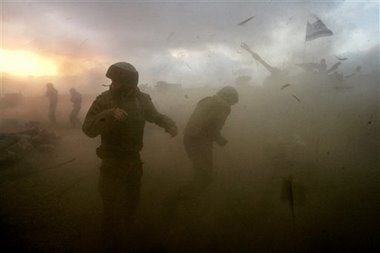 The series of events: abductions of Israeli soldiers by Hamas and Hizbollah, the Israeli air assaults on Gaza and Lebanon, the rockets fired by Hizbollah [corrected from ‘Hamas’: 7-17-2006] into Haifa and other parts of northern Israel, the Israeli artillery responding–all of these happenings and more now amount to the larger picture–a new Middle East war.
America supplies Israel with enormous airpower, and war jets (F-15s and the like) are able to destroy parts of large, visible targets like the Lebanon airport and the Hizbollah TV headquarters. But how much does this really further Israel’s war aims, and how much does it give Israeli Prime Minister Ehud Olmert and his cabinet an exaggerated sense of power?
Did Israel overplay its hand due to its military reach and fall into a dangerous provocation? The attack on the airport near Beirut was followed by an attack on an Israeli warship off the coast, which has reported four sailors missing, Reuters writes, and continues:
“Israeli media have said the ship was hit by an airborne drone packed with explosives late on Friday. The army said the vessel was badly damaged and had been towed back to Israel.”
Hizbollah is definitely using some serious hardware in their attacks, perhaps with some connivance of official powers in Lebannon. Long thought of by some as a Shia proxy of Iran, it may have backing from the Iranians on some weaponry. If that is true, then bombing oil tankers and U.S. Naval vessels in the straits of the Persian Gulf would be like shooting, say, shooting fish in the barrel, by the way. Regardless, war mongers have found the war planets (Mars and stuff..) in line or something, and are cheering for more blood, like “Moonbat” Michael Ledeen here:
“The only way we are going to win this war is to bring down those regimes in Tehran and Damascus, and they are not going to fall as a result of fighting between their terrorist proxies in Gaza and Lebanon on the one hand, and Israel on the other. Only the United States can accomplish it.”
America has enough to deal with right now, like overcoming the moralizing pretensions of chicken-hawks like Joe Lieberman and George W. Bush and withdrawing from Iraq (that, at least, is the view of this chicken-dove: that while America has unleashed a nightmare in Iraq, that is not what it was trying to do; so now, I do not envision that American power is working toward a compounded nightmare, however..you see where I am going with this), and any suggestion of attacking Iran or Syria because of this new war by the Mediteranean is stupid and absurd. Those trying to draw America into a third front (after Afghanistan and Iraq) should reconsider.
As for those directly involved in this mess–Israel, Hizbollah controlled southern Lebanon (and it’s hard to tell how much else of the country) and Hamas-administered Palestine–they should all realize that last month’s angry stalemate is better than today’s war. But many in all three places may doubt that, and those in Gaza must be wondering what all that talk of “withdrawal” was all about. But for all these groups, those playing them off each other are complicit in what is happening, including the attacks on civilians and disproportionate escalations.
This war is a proxy war to some extent–none of these groups could fund their military or paramilitary operations on their own, which sends a clear message: that all regional powers should stop arming them.
[photo: AP]
Record Review: Neil Young, ‘Living With War,’ 2006
 Neil Young’s new album, Living with War, is a remarkable rock album with a bold political agenda and a patriotic tone. Where it is easy to hear criticism of the Bush administration in 2004’s Greendale after a few listens, ‘Living With War’ proclaims “Let’s impeach the president for lying/Thank God/Thank God” on and goes on from there. Where ‘Greendale”s “Leave the Driving [to us]” snarked, ‘Living With War”s “Restless Consumer” attacks without quarter: “Don’t need no Madison Avenue War/…/Don’t need no more lies”.
The songwriting in ‘Living With War’, the rock guitar with Young’s distorted chords and solos accompanied by a good band and occasional backup singers or horns makes for an outstanding collection of rock songs, enjoyable for Neil Young‘s fans but accessible to any fan of rock. “Listening to Bob Dylan singing, in 1963/Watching the flags of freedom flying.”
Sometimes the words can seem powerful set to music, but Young’s lyrics about Iraq are devestating, really because of the weight of the issue and the starkness he portrays:
“Back in the days of shock and awe/We came to liberate them all/History was a cruel judge of overconfidence/…/Thousands buried in the ground.”
World Cup: France’s truimph, Germany’s anguish; Italy’s chances; Portugal collapses, after England implodes
 Germany had drawn praise for their attacking style, for their now-popular coach Jürgen Klinsmann, and for star forward Miroslav Klose’s goals. But after a scoreless regular time and well into the second half of overtime, Italy scored a goal off of a few sharp passes in the penalty area, then gained another point from their feared counterattack right after to finish the game off 2-0.
Italy is a highly-skilled team that was every bit a match for 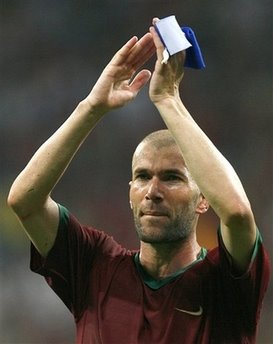 the very strong German side. They will probably enter the final game as the favorites, given their impressive win and strong performance throughout the World Cup. The other team in the final won a close and difficult match against Portugal that saw a fearsome corner kick very near the end as Portugal tried relentlessly for the equalizer, even seeing their goalie make a feed toward the goal from probably only 35 yards out. But Portugal could never overcome the one goal scored by Zinédine Zidane on a penalty kick in the first half. France has seen an amazing performance from their captain in terms of skills and leadership. Portugal did not create enough chances against France but they had had an impressive run, advancing to the semifinals after a hotly argued game against England in the previous round. England striker Wayne Rooney and Portugal star Cristiano Ronaldo were at odds early in the second half, culminating in a kick toward the groin from Rooney and a slow-developing red card from the referee. As the English search for villains, they have pointed a lot of fingers in many directions, including Rooney, departing coach Sven-Goran Eriksson, and David Beckham, who has announced that he is stepping down as England’s team captain.
[photos: German fans by AFP; Zinédine Zidane by AP]
San Francisco Bay and the lights of the Wharf

Jessica and I met some friends in North Beach and we had some food and wine in one of the small places on Grant. It was a very nice evening at the small restaurant, with good red wine and lively conversation and a flamenco guitarist playing in the background. I walked outside for a while at one point and took a few pictures from Telegraph Hill.
Obrador for president of Mexico 2006
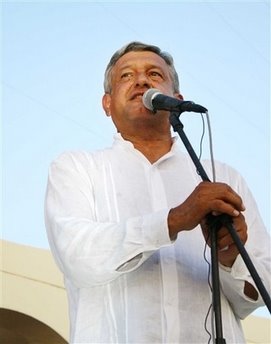 Vicente Fox has seen one anti-climatic failure after another during his term of office. His anointed successor, Felipe Calderon, had been leading in the polls for president. (The PRI has failed to field a successful comeback candidate–Roberto Madrazo looks out of the running.) Now Calderon, the PAN candidate, appears to be in a too-close-to-call finish to the race with PRD candidate Andres Manuel López Obrador.
Now the question for Mexican voters comes down to a judgment on Fox’s term. His six years in office started with great fanfare and expectations. In the first months of George W. Bush’s first term Mexico was treated like the most important ally. It is hard to believe that now given the tensions between the countries, mostly instigated by right-wing Republicans but reaching to areas such as support for the Iraq invasion (Mexico did not give it). The international record of Fox in other matters includes making enemies with Venezuelan president Hugo Chavez recently and a May 2004 diplomatic row with Cuba, traditionally a country with good or decent relations with Mexico.
Domestically, Fox has never managed to gain a legislative majority for his PAN party and has not passed many of the reforms he came in promising. Would Calderon do any better in a country that seems unlikely to elect a right-leaning majority any time soon? The sale of oil has brought revenues, and Fox has overseen some economic progress. But just as Brazil’s Lula was treated like a bogeyman before his election, many publications like to portray Obrador, a former Mexico City mayor, as a left-wing revolutionary. The New Republic went to its normal depths by portraying Obrador as a fire-breathing, pistol-slinging Tobasco comrade cowboy, while The Economist hissed thusly on Obrador’s debate performance: “His man kept his sometimes volatile temper under tight control. But he seemed punch-drunk at times, oddly swaying back and forth. Having been the frontrunner for so long, he seems to have forgotten how to play the challenger.“
When a man has enemies like these, who call him “angry” because of their anger at his relatively positive and optimistic plans for a more progressive agenda in a country still dealing with large areas of poverty and crime, it is time for the people of Mexico to make him their president.
[photo: AP]
Sonoma County
The town of Sonoma was very busy yesterday, a warm sunny day even in San Francisco that got quite hot by the time we crossed the Golden Gate Bridge and rolled through Marin County and on into wine country. The fountain in Sonoma is being worked on, but the town square was filled with parties and picnics and the stores overlooking the square were filled with shoppers and vacationers. The wineries we went to were busy, but the Buena Vista Winery down in the Carneros area was a nice find, shaded and hidden at the end of the road with serious-looking stone buildings and a lively tasting room. The ground, where it is not covered with irrigated vines, is yellower and drier than I had expected for this early in the summer. Some of the cows we saw from the highway were beautiful–some almost all black, some almost all white, some with brown and grey splotches. Coastal California cows are a fascinating type of herd to look at because of those colors mixing with the yellow grass background, and because they crowd together on terraces in close formation.
Haight Street Fair 2006

I wandered through the crowd at the Haight Street Fair in San Francisco this afternoon around 4:30 p.m., and it seemed like the unyielding but mild fog was starting to disperse the festivities slightly. A band was playing on a stage in front of Amoeba Records, and it seemed like enthusiastic fans thronged several rows back before the crowd turned into the more casual partyers. Haight Street seemed pretty filled the other direction toward Ashbury as well, but I walked on toward Golden Gate Park from the festival area.
Jessica was at the festival earlier, and she said that a lot of the people were drunk. “But not happy drunk. There were a lot of thug-kind of people there.” After thinking about it, she terms it an “underwhelming affair.”
Gordon Brown in 2009 – well maybe 2010 at this point

David Cameron would love the chance to become the next Prime Minister. Making noise–the baying of the powerless Leader of the Opposition in the House of Commons, remember: the policies of the “shadow cabinet”–about the environment is all quite impressive, but then we know you Tories aren’t like these red Republicans out here stateside. And why do we know that? Well for one thing Bush’s apparatus refused to even meet with the Conservative Party delegation to the 2004 Republican Convention in New York.
That episode was just more proof of the power of the enormously ruthless and clever Tony Blair, the brightest European politician of his generation and an embarrassingly brainy contrast to George W. Bush. Even as Tony Blair held onto power (with a reduced majority, however) in 2005, Romano Prodi’s win in Italy this year represents the second domino in the fall of right-wing governments from the “Coalition of the Willing” in Europe. After Spain’s Jose Maria Aznar failed to see his replacement elected in 2004, former European Commission Prodi took the left to power, replacing underworld figure Silvio Burlusconi. But as Blair’s Labour government is theoretically on the left, does that leave him immune to the same discontents, even as British guarded Basra has seen security problems and the NATO force is taking on a difficult area of Afghanistan? This problem is probably the largest foreign policy issue facing Blair’s government as it runs out of support due to a range of scandals.
“Cash-for-honours” is an inside-Westminster kind of scandal. Those not interested in the arcana of Lords reform proposals and English election law may find it to seem like a relatively minor influence-peddling plus fund-raising operation.
Dr. John Reid, who seemed to be casting aspersions on the relevance of the Geneva Conventions (regrettable especially for an ally often presuming to lecture the US on human rights issues) while Defence Minster, is now charged with running the Home Office. Whether putting that loyal Blair acolyte in charge of that enormous, secretive police department will calm the political uproar over perceptions of incompetence (civil servant and ministerial) is debatable.
Tax credits, education funding and the NHS are also recent areas of debate. These more than others have to do with Chancellor of the Exchequer Gordon Brown, who will have to be seen as sorting problems out in domestic policy before he can take over the Prime Minster’s Office at No. 10 Downing Street.
The strangest scandal involves Deputy Prime Minister John Prescott. Perceived as a Labour man, apparently, by party loyalists, he has been compromised by news of an affair with a staffer, Tracy Temple. When Blair reshuffled his cabinet recently, he took away some of Prescott’s responsibilities. Recently Prescott was filmed playing croquet at a country estate reserved for the Dep. PM. Due to embarrassment, he is now giving up his use of the house. (He gave an interview to the Guardian here.) Prescott seems to be trying to tie his fate to that of Blair–which is a bad sign, as Blair is by now perceived as somewhat damaged goods, and it just shows you how troubled Prescott is right now. When he sat behind Blair during the weekly Prime Minister’s Questions in Parliament, Prescott often seemed to be talking, signaling or joking–perhaps not about the subject at hand, but with enthusiasm. Gordon Brown looks more often like he is quite angry that anyone would dare drag him out of bed and make him listen to Blair. But apparently, in the mysterious rooms of Whitehall it is Brown who is respected perhaps a bit and highly feared whereas Prescott is said to be good at chairing committee meetings, something even less important in Britain than in America.
Due to the series of scandals (whether somewhat media-fed or absolutely genuine, they turned into an embarrassing frenzy that hurt Labour’s image), Tony Blair has to finish out the year by trying to make some progress on domestic issues while giving up his office at the beginning of 2007.
When the comparisons are made with Tory problems in the 1990s with Blair’s government, they are largely laughable. The last nine years have seen remarkable economic stability in Britain, while public services are improving if not good. Gordon Brown, along with Blair, is largely responsible for the sound fiscal management that has helped create conditions for growth in Britain. As much as it is true that Blair is authoritarian (in his taste for detention powers, ID cards and war) and has made many mistakes, a Tory government would not be more liberal-minded and it would be amateur hour by comparison on economic issues. Blair should step aside soon to let Gordon Brown make this case for the 2009 election.
[photo: AP]