Israel’s "deliberate destruction of Lebanese civilian infrastructure"

An Amnesty International report describes the scale and nature of Israel‘s war crimes during its recent campaign in Lebanon. In part, it reads:
“First-hand information gathered by recent Amnesty International research missions to
Lebanon and Israel points to an Israeli policy of deliberate destruction of Lebanese civilian infrastructure during the recent conflict.
The long-term impact of the destruction of
Lebanon’s infrastructure on the lives of the country’s men, women and children is incalculable. Many have lost their homes while having to cope with the deaths of loved ones or struggling to overcome severe injuries. Many more have lost their livelihoods. Records showing home and property ownership have been destroyed, adding to the difficulties of rebuilding lives.
The head of the country’s Council for Development and Reconstruction, Fadl Shalak, said on 16 August that the damage incurred amounted to US $3.5 billion: US $2 billion for buildings and US $1.5 billion for infrastructure such as bridges, roads and power plants.”

Leon Wieseltier, a supporter of Israel’s side in the Lebanon war of 2006 writing in the New Republic, still considers the cowardice of the claims of Israel’s leaders to moral superiority after committing atrocities themselves:
“But a right war in which such outrages occur–surely it is not enough to refresh one’s sense of the admirable nature of one’s principles and be done. The fact that you are not a monster is beside the point when you have just done something monstrous. One should not be consoled for one’s misdeeds, one should regret them; and regret is genuine only when it is beyond the reach of consolation. If your guilt reminds you of how otherwise guiltless you are, then you have not been improved by the discovery of your sin, you have been corrupted by it. It is important also to be wary of the pride of self-criticism. At least we worry about such things: this proves only that the standard is low. To congratulate oneself upon the severity of one’s self-reckoning is to vitiate it–to nullify conscience by reference to its very exercise.”
An AP article reports Israel‘s defensive reaction, much in line with what Leon Wieseltier warns against in the previous passage:
“Mark Regev, a spokesman for
Israel‘s Foreign Ministry, said his country acted legally.
“Israel’s actions in Lebanon were in accordance with recognized norms of behavior during conflicts and with relevant international law,” he said. “Unlike Hezbollah, we did not deliberately target the Lebanese civilian population. On the contrary, under very difficult circumstances, we tried to be as surgical as is humanly possible in targeting the Hezbollah terrorist organization.”
Regev said that Lebanese infrastructure was “targeted only when that infrastructure was being exploited by the Hezbollah machine, and this is in accordance with the rules of war.”
Israel suffered international condemnation when it attacked targets in southern Lebanon hours after Hezbollah guerrillas operating there killed three Israeli soldiers and captured two in a cross-border raid July 12.
The Israeli Defense Force has said that between that raid and the Aug. 14 U.N.-brokered cease-fire, it launched more than 7,000 air attacks on Lebanese targets and the navy conducted about 2,500 bombardments.
The United Nations children’s fund,
UNICEF, estimates that some 1,183 people died, mostly civilians and about a third of them children, while the Lebanese Higher Relief Council says 4,054 people were injured and 970,000 displaced. U.N. officials reported that around 15,000 civilian homes were destroyed.”

[photos: Ehud Olmert by Reuters; IAF General Dan Halutz by AFP; south Beirut by Reuters]

Pluto is no longer (quite) a planet


Xena, another small celestial entity in the outer reaches of the solar system, was being considered as an addition to the solar system’s planets. But it now appears, in a surprising but perhaps inevitable development, Pluto is being decertified as a planet instead. This is what the New York Times says in Wednesday’s edition: The new definition offered yesterday would set up a three-tiered classification scheme with eight ‘planets’; a group of ‘dwarf planets’ that would include Pluto, Ceres, Xena and many other icy balls in the outer solar system; and thousands of ‘smaller solar system bodies,’ like comets and asteroids. The bottom line, said the Harvard astronomer Owen Gingerich, chairman of the Planet Definition Committee of the union, is that in the new definition, ‘Pluto is not a planet.’
A long argument may ensue over whether Pluto is really a kind of planet or not. Reuters reports a slightly different interpretation:
Under the new definition, schoolchildren will be relieved to know that, just as they were taught, Pluto will remain a planet. But it would also fall into a newly created category called plutons, which are distinguished from classical planets in that they take longer than 200 years to orbit the sun. Pluto would be joined in this new category by two other celestial bodies, Xena and Charon, while another, Ceres, would be known as a dwarf planet.
Another development of note is the recent claim that proof now exists for dark matter because of a galactic collision. A BBC science article describes the findings:
The researchers have discovered what is effectively the gravitational signature of dark matter. This signature was created by dark matter and ordinary matter being wrenched apart by the immense collision of two large galaxy clusters.
[illustration of Xena: NASA/AP]

‘Where are you calling from sir?’

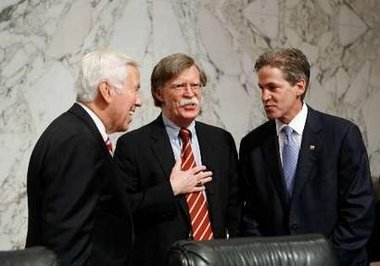
Norm Coleman loudly called for UN Secretary General Kofi Annan to resign in 2004. As CNN reported:
“The
U.S. senator leading the investigation into allegations of corruption and mismanagement in the Iraq oil-for-food program is urging U.N. Secretary-General Kofi Annan to resign, saying the ‘massive scope of this debacle demands nothing less.’
Annan declined to comment on the call, made by Sen. Norm Coleman, R-Minnesota, in an opinion piece in Wednesday’s Wall Street Journal.”

Now Annan is still in his position even after the oil-for-food investigation and his pronouncement that the
Iraq war was illegal. I wondered if Coleman, a Senator from Minnesota, still longed for Annan’s removal so I called his Washington office.
“Where are you calling from sir?” After asking for my name and web site, the staffer that answered the phone checked if the press secretary was in, but unfortunately he wasn’t. Offered voicemail, I decided instead to see if she could help me. After she deflected two questions about Annan, I went with a pretty straightforward one, but still faced obfuscation–here’s the exchange:
Dinosaur Country Tribune: Is he in touch with the people of Minnosata on the
Iraq, um, issue?
Coleman staffer: Sir, I would definitely will have to get you the press–the senator’s press secratary, I cannot comment for the Senator on this issue.”
[photo: Reuters – Coleman with Richard Lugar and John Bolton in July 2006]

Problems with profiling

Hysteria led to a loud, obnoxious woman on a trans-Atlantic flight with “a tub of handcream that should have been detected” to be put in handcuffs and the plane to be diverted, reports The Times of London:
“Airline passengers throughout the European Union face tougher security measures as part of a seven-point anti-terrorism package outlined after a meeting of interior ministers yesterday. Two key measures are to be discussed by EU transport ministers next week, including extending the British hand baggage restrictions to all member states. The EU is also to look at introducing a requirement on airlines to provide advance information on passengers, as already happens on flights to the United States. The concern over airline security was highlighted yesterday when a United Airlines flight to Washington from Heathrow was diverted after a passenger suffering from claustrophobia caused a security alert. Two F16 fighter jets escorted Flight 0923 to Boston Logan airport after the pilot announced a mid-air emergency. The woman, 59, from Vermont in the US, became disruptive and agitated several hours into the eight-hour flight and argued with a flight steward. A crew-member provided handcuffs and two male passengers sat on either side of her until the Boeing 763 landed.”

The Times also reports on the feelings of the British public about the recent bomb scare and terror arrests:
“A majority of voters support moves by the Government to introduce security screening at airports that focuses on the passengers who pose the greatest risk. A poll in today’s Spectator shows that 55 per cent backed the idea of passenger profiling and only 29 per cent opposed it. The Times disclosed this week that the Government was in talks with airlines about profiling people who behave suspiciously, have unusual travel patterns or, more controversially, are from certain ethnic or religious backgrounds. Half of the 1,700 respondents said that most British Muslims were moderates but 28 per cent disagreed and almost as many said that they did not know.”
Glenda Jackson, a Labour member of Parliament,
questions the value of the current widespread anti-Muslim feeling and clamor for profiling in Britain’s Guardian:
“Do ministers really believe the way to convince disaffected young Muslims that our war is with the terrorists, rather than the Islamic faith, is to start body-searching them on the basis of their race and religion? Does the prime minister really believe that Muslim leaders will be able to convince their communities that current investigations are following due process when his home secretary passes verdict on “the main players” before a single person has been charged? And does anyone seriously believe that benefits from blanket profiling will make up for the commensurate breakdown in trust between those who are subject to this scrutiny and the security services who depend on their cooperation to avert future atrocities?”
A BBC report (video) about the bomb plot case claims that “some suspects will be charged,” and that some will “almost inevitably be released.”
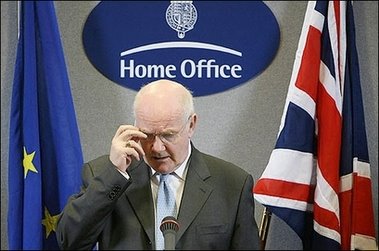
[photos: British police on Downing Street by AP; John Reid by AFP]

The disastrous, desperate conditions in Somalia

Somalia is in a desperate state, with a constant threat of violence and famine. Control is divided between an Islamist “Courts” militia and a foreign-backed government. Reuters via the New York Times describes the situation:

“Foreign states, particularly Ethiopia and Eritrea, must stop supporting the rival factions or risk inflaming the situation, the International Crisis Group (ICG) said in a report.

“Unless the crisis is contained, it threatens to draw in a widening array of state actors, foreign jihadi extremists and al Qaeda,” said the report, entitled “Can the Somali Crisis Be Contained?”

The interim government of Ethiopian-backed President Abdullahi Yusuf has had its brittle authority challenged by a group of militarily superior Islamists, whom U.N. monitors say have received Eritrean military support.

The Islamists seized Mogadishu and its environs in June after routing warlords who had ruled Somalia since the 1991 ouster of dictator Mohamed Siad Barre.

“The prospects for a peaceful resolution of the present crisis are poor,” ICG said.”

The Economist reports on the disaster in the region overall:

“The scale of potential misery is becoming clearer. Rough estimates of famine victims in the next few years range upwards from 10m. The risk of whole areas of the Horn collapsing with famine and irreversible environmental damage, urged on by jihadist and tribal clashes, is clear cause for alarm.”

Nearby Kenya has an appeal posted on it right now at the World Food Program site:

WFP is fast running out of emergency food aid for millions of people affected by drought in Kenya and has appealed for urgent new contributions to prevent malnutrition rates rising as the long dry season sets in. WFP is feeding a total of 3.6 million people in 25 of Kenya‘s 70 districts because of drought — 3.1 million people receive monthly rations and 535,000 children are given school meals.”

[photo: AFP]

Bill Emmott’s gone, but the Economist still loves the Iraq war


The Iraq disaster continues, with an ongoing occupation unable to stop continuing violence. America and Britain are in a mess and need to withdraw. Voters in Connecticut’s Democratic senate primary chose antiwar Ned Lamont over neoconservative Joe Lieberman, so now Lamont is taking the party that direction, as noted in the Washington Post:
“Democratic Senate nominee Ned Lamont will launch a general election bid in Connecticut next week with an expanded campaign operation of Washington-based reinforcements, in preparation for a bitter brawl with Sen. Joseph I. Lieberman over the Iraq war and national security.
Lamont’s upset of the three-term senator and former Democratic vice presidential nominee, who is now running to keep his seat as an independent, has forced a hasty reordering of political alliances, as prominent Democratic leaders and organizations shift their support to Lamont. The political novice is seeking help from party veterans in fundraising and communications, and in answering Lieberman’s increasingly aggressive war defense.”

But many magazine and blog writers are still lifting pens and typing keys for the “grand vision New Middle East democratization etc.” project and straying into delusion. Outside the Economist offices, is anyone else disputing whether
Iraq is in a civil war? Referring to Iraqi prime minister al-Maliki:
“But he still needs the Americans badly, especially in
Baghdad, where he has called them in as reinforcements to staunch the sectarian bloodshed; without them, it would be even worse, and civil war might indisputably arrive.” So Bill Emmott is gone but the war still has supporters down in St. James. Very well, if increasingly irrelevant. Now to the right-wing blogs–as usual reprinting administration propaganda, this time directly via Byron York on the National Review online:
“‘And I think that’s in part because at the end of the day people look at the consequences of failure and the consequences of victory, the consequences of withdrawal and the consequences of finishing the fight, and they draw very important lessons about what it means to our country.'”
So as long as the administration is still talking about the “consequences of victory,” no real discussion can occur, but it’s all..very..bizarre..and shameful.
[photos: Bill Emmott by bsme.com, Iraqis by AP]

"Travelers are going to be inconvenienced"


George W. Bush said that the British bomb plot was a “stark reminder this nation is at war with Islamic fascists who will use any means to destroy those of us who love freedom, to hurt our nation. I want to thank, uh, the government of Tony Blair, and officials in the United Kingdom–“
For radicalizing his Muslim subjects? The plotters were largely British-born Muslims. Whatever you want to call these people–“fascists,” or whatever–they are British. How does that comport with “fighting them over there so we don’t have to fight them over here?” Also, why the award show-style thank-yous? Then, Bush continued:
“for their good work, in busting this plot. I thank the officials in Washington D.C. and around the country […] Travelers are going to be inconvenienced […] The American people need to know we live in a dangerous world, but our government will do everything we can to protect our people from these dangers.”
Not being able to take a few bottles of water or pop onto a flight is an onerous burden to put on the air travel consumer, whatever Bush wants to “urge” people to do. And taking more rights away from passengers to try to compensate for inadequate bomb detection equipment must be weighed against the problems of dehydration and lack of caffeine for millions of travelers.
So Bush used the occasion to typically try to induce fear and paranoia (it is an election season). Though he talked about “cooperation” with Britain, it is questionable how much cooperation occurred when all the action seemed to be in Britain and Pakistan anyway, as the Guardian reports:
“A brother of one of the 24 suspects seized by detectives investigating a plot to bomb up to 12 planes was seized in Pakistan shortly before police launched their raids, it emerged tonight. The arrest of Rashid Rauf in the border area with Afghanistan was a trigger that led anti-terrorist investigators to start an immediate pre-emptive operation with officers fearing that the alleged cells were ready to strike. […] It also emerged today that at least one of the suspects arrested in Walthamstow, east London, regularly attended Islamic camps run by Tablighi Jamaat, an organisation which the Americans believe has been used as a recruiting ground for al-Qaida.”

The New Republic online has posted a piece by Scotsman newspaper writer Alex Massie. One key paragraph follows from the piece:
“In the days to come, we will surely hear bleating that British support for the war in Iraq has increased the threat […] Britain faces. (Certainly, there is neat symmetry in targeting British and American aircraft leaving London for the United States.) But Iraq alone has not radicalized British Muslims. Nearly 5,000 British troops are garrisoned and fighting in Afghanistan, and the British youths who attended training camps in the Hindu Kush are unlikely to look too kindly upon them. In other words, Iraq may have exacerbated the threat, but it did not cause it. Anyway, to treat the Afghan invasion as a just cause for domestic terrorism is to argue that there should have been no military response to September 11.”
Well, let the “bleating” begin. First of all, this all amounts to a flawed circular reasoning working its way back to that great rhetorical bludgeon of war-mongers on both sides of the Atlantic–“September 11.” Somehow Massie hopes we will forget the earlier parts of the paragraph, including the strangely constructed “unlikely to look too kindly” argument and the concession almost upfront that the bleaters have a point (“Iraq alone has not radicalized British Muslims”). The article is just another platform for anti-Muslim tirades, which are coming fast and furious these days. Consider what Massie says:
“This disdain for their homeland, it should be noted, comes despite […] Britain’s record as a tolerant and liberal country–just as much, if not more, than any other European country. Britishness has always been a baggy concept, requiring little from immigrants.”
Not only is this convenient to say but hard to back up (the reality of intolerance and racism in Britain is actually rather more sinister than he would like to admit, especially in northern English towns), but it is very possible that Massie actually stole the “baggy” idea from the article he links to! Consider this from the Guardian piece by Timothy Garton Ash that the New Republic article contains a link to:
“I have always thought that the very undemanding vagueness, the duffle-coat bagginess of Britishness was an advantage when it comes to making immigrants and their descendants feel at home here. After all, what have you traditionally required in order to be British?”
Well with all this talk about “undemanding” Britishness that’s “requiring little from immigrants,” consider this notice from the Southern Poverty Law Center:
“The British National Party (
BNP), a neofascist political party that limits membership to whites, more than doubled its number of local councilors in British elections this May [2006], shocking anti-racist leaders and the political establishment.”
All this talk about “Britishness” is both offensive and unconvincing, but then what of the troubles with integrating Muslims into European societies. Do the British Muslims (many of the them from Pakistan, Bangladesh and India) want to integrate, the way the “baggy” people see it? At the end of the day, one thing is clear–Jacques Chirac respected the will of his Muslim citizens (many Algerian), while Tony Blair signed on to an appalling aggression in Iraq in defiance of his. A mass of French Muslims tipped cars and set them aflame in their suburban slums in late 2005, while a handful of British Muslims blew up transit vehicles in July 2005. While French society has a high tolerance for protests, scuffles, migrations, even riots and revolutions from time to time and may yet take absorbing Muslims in stride (relatively speaking), Britain has now after the July 7 attacks in 2005 discovered another apparent group of angry British-born Muslim fanatics ready to commit mass murder. However much some Brits want to congratulate themselves for being so much of a “tolerant and liberal country,” they have a major problem on their hand
s with their own native-born subjects that has little to do with religion and distant terror networks and a great deal to do with their own society and its racism and the limited opportunities its offers the children and grandchildern of South Asian migrants.
From BBC News:
“It is thought that the group of suspects were planning to blow up several planes by using liquid explosives carried in soft-drink bottles, and detonators disguised as electronic equipment. UK police said the explosions could have caused “mass murder on an unimaginable scale”. As a result of fears over liquid explosives, all liquids are among items now banned from the cabins of planes taking off from the UK.”
The events surrounding the apparent bomb plot might be a big deal–but they haven’t been enough to convince Tony Blair to end his Barbados vacation. According to
BBC News:
“Prime Minister Tony Blair is on holiday in Barbados but Downing Street says he is in “constant contact.”
There was no indication that action was going to be taken “imminently” against the alleged terrorist plot when Mr Blair left the country, said Mr Reid – that had only become clear in the last 24 hours.”
While Blair is gone, it isn’t even clear who is in charge of Britain, declared the Times online:
“Today it looks very much as if John Reid is in charge of the Government, starting from this morning at a dramatic press briefing when he announced that the country was on “critical” alert.
It was the Home Secretary who swiftly chaired two meetings of the Cobra committee, one late last night and one this morning to hear the results of the pre-emptive action taken by the police and security services. But Mr Prescott was also busy, in talks with Muslim organisations.”
[photos: Heathrow Airport–American traveler by AP, plane overhead by Reuters, armed British policeman by Reuters]